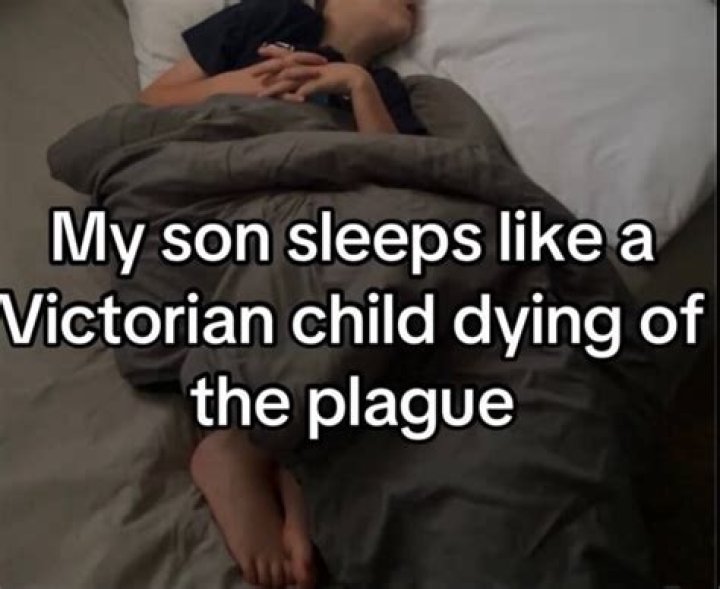
My Son Looks Like a Dying Victorian Child When Sleeping: What Parents See
 Christopher Martinez
If you've ever walked into your child's bedroom at night and stopped dead in your tracks because your son looks eerily like he belongs in a 19th-century mourning photograph, you're not alone. This peculiar observation has become a widespread joke among parents on social media, with thousands sharing photos and stories about their children's uncanny resemblance to Victorian-era post-mortem portraits during sleep. The combination of pale skin, limp limbs draped at odd angles, and an expression of profound stillness creates an image that's both endearing and slightly unsettling.
The phenomenon speaks to something deeper than just a funny comparison. It taps into our collective cultural memory of Victorian mourning practices, the specific aesthetic of children's portraiture from that era, and the universal experience of watching our children sleep. Parents describe checking for breathing, noticing the dramatic positioning of hands across the chest or forehead, and the way nighttime shadows fall across young faces to create that distinctly historical appearance.
Why Victorian Child Comparisons Resonate With Modern Parents
Victorian photography had a distinctive quality that makes these comparisons so apt. During the mid-to-late 1800s, photography required long exposure times. Children had to remain absolutely still, often appearing pale and solemn in formal portraits. The lighting was natural and often dim, creating shadows and a certain pallor that we now associate with that era's imagery.
When your son sleeps, several factors converge to recreate this aesthetic. Blood flow changes during deep sleep, causing skin to appear paler than during waking hours. The complete stillness of sleep mirrors the motionless quality required for early photography. Children often adopt dramatic sleeping positions—one arm flung across the forehead, the other resting on the chest—that echo the formal poses Victorian families arranged for portraits.
The humor comes from recognition. We've all seen those historical photographs in museums or history books. The stiff poses, serious expressions, and formal clothing created an atmosphere that modern viewers find both fascinating and morbid. When that same visual quality appears in our own homes, the cognitive dissonance between our vibrant, energetic children and their nocturnal Victorian doppelgangers creates comedy gold.
The Science Behind Sleep Appearance Changes
There are legitimate physiological reasons why children look different when sleeping. During REM and deep sleep stages, blood pressure drops slightly and circulation patterns shift. This causes a natural paleness, particularly noticeable in children with fair skin. The muscles relax completely, eliminating the subtle tension that gives faces their animated quality during waking hours.
Children's skin is thinner than adult skin, making blood vessels more visible. In low light conditions typical of nighttime bedroom checks, this translucency can create an almost translucent quality. Combined with the shadows cast by nightlights or hallway light filtering through doorways, the visual effect genuinely recalls Victorian-era photography techniques that emphasized contrast and captured subjects in subdued lighting.
The positioning matters too. Children's bodies are incredibly flexible, and during sleep they contort into positions that would be uncomfortable for adults. A hand draped dramatically across the forehead, legs at unusual angles, or a head tilted back in complete abandon—these poses happen naturally during sleep cycles but look remarkably deliberate, as if staged for a formal photograph.
Common Sleeping Poses That Trigger the Comparison
- The "Consumption Patient" – lying on back with one hand across forehead, eyes closed, mouth slightly open, looking as though overcome by a fever
- The "Tragic Poet" – dramatic side profile with hand resting on chest, face tilted upward, capturing the melancholic aesthetic of Romantic-era portraiture
- The "Angelic Repose" – arms crossed over chest, completely still, creating the peaceful but unsettling appearance of Victorian memorial photography
- The "Fallen Cherub" – sprawled across the bed at odd angles with limbs askew, pale skin glowing in dim light, evoking Renaissance paintings of sleeping putti
- The "Orphan Oliver" – curled in a small ball with hollow-looking cheeks emphasized by shadows, reminiscent of Dickensian illustrations
Cultural Context: Victorian Mourning Photography
To understand why this comparison resonates, we need to look at Victorian mourning culture. Post-mortem photography was common practice in the 19th century, particularly for children. Infant mortality rates were high, and for many families, a post-mortem photograph might be the only image they'd ever have of a child. Photographers posed deceased children to look peaceful, often with eyes painted on closed lids or propped into lifelike positions.
These photographs weren't considered morbid at the time—they were treasured keepsakes. But viewing them through a modern lens, they possess an eerie quality that our culture finds both fascinating and uncomfortable. Living children photographed during that same era often shared similar visual qualities: formal poses, serious expressions, simple clothing, and that characteristic stillness.
When parents joke about their sleeping children looking Victorian, they're usually referencing both types of imagery—the living children's formal portraits and the memorial photographs. The joke works because we're far enough removed from Victorian mourning practices to find humor in the comparison, but the visual similarity is striking enough to be immediately recognizable.
Why This Joke Went Viral on Social Media
The "dying Victorian child" comparison exploded on platforms like Twitter, Instagram, and TikTok because it captured something universal that parents hadn't quite articulated before. Someone put words to an observation many had made privately, and suddenly thousands of parents were sharing their own photos and experiences.
Parenting humor often works best when it's specific yet relatable. This particular observation checks both boxes. It's highly specific—not just "my kid looks weird when sleeping" but a precise historical aesthetic reference. Yet it's broadly relatable because the visual phenomenon occurs across different families, skin tones, and sleeping environments.
The meme also plays into a larger trend of parents finding humor in the gap between their children's waking and sleeping selves. The energetic, loud, demanding child who runs through the house becomes an ethereal, peaceful, disturbingly still figure at night. That transformation itself is worth noting, and the Victorian comparison gives it perfect framing.
Photography Tips for Capturing the Aesthetic (Safely)
If you want to document this phenomenon for your own amusement—and future embarrassment of your child—a few photography considerations help. Natural light works best, particularly the soft light of early morning or the dim glow from a hallway. Avoid using flash, which will both wake the child and eliminate the atmospheric shadows that create the effect.
Black and white conversion enhances the Victorian quality by removing modern color cues. A slight increase in contrast and reduction in highlights can push the image closer to that historical aesthetic without heavy editing. Some parents add a subtle sepia tone or slight grain to complete the effect.
Never stage or pose a sleeping child for these photos—that defeats the entire point and could be unsafe. The humor lies in the natural, spontaneous positions children adopt during sleep. Document what you find, don't create it.
When to Actually Check on Your Sleeping Child
While the Victorian child aesthetic is usually just funny, it's worth knowing when a sleeping appearance might indicate something worth monitoring. Extremely pale skin combined with bluish lips or fingernails could indicate poor circulation or breathing issues. Unusual breathing patterns, prolonged periods without visible breathing movement, or inability to rouse your child with gentle stimulation warrant immediate medical attention.
Most of the time, though, the pale, dramatic appearance is simply the normal result of sleep physiology combined with low lighting and your child's natural sleeping position. If your child is breathing normally, their color returns when you turn on a light, and they respond to gentle touch, they're fine—just cosmically channeling a different century.
The Parenting Experience of Nighttime Checks
There's something primal about checking on sleeping children. Even when we know they're fine, we still creep into their rooms to watch them breathe. That nightly ritual takes us from the chaos of bedtime battles and the demands of waking hours into these quiet moments where our children look peaceful, vulnerable, and sometimes hilariously dramatic.
The Victorian child observation is part of a long tradition of parents finding humor in these nighttime experiences. Previous generations joked about children sleeping in impossible positions or the way they'd be sprawled across the bed leaving no room for anyone else. This generation's version just happens to include a specific historical aesthetic reference that resonates with our collective visual literacy around Victorian imagery.
Frequently Asked Questions
Is it normal for my child to look pale when sleeping?
Yes, it's completely normal for children to appear paler during sleep due to changes in circulation and blood pressure. Blood flow decreases slightly during deep sleep stages, and this is particularly noticeable in fair-skinned children. As long as your child's color returns to normal when awake and there are no other concerning symptoms like blue lips or difficulty breathing, the paleness is simply a natural part of sleep physiology.
Why do children sleep in such dramatic positions?
Children's bodies are remarkably flexible, and during sleep they cycle through various positions as they move between sleep stages. Unlike adults who've learned to sleep in more controlled positions, children haven't developed those habits and their muscles relax completely, allowing them to contort into positions that look dramatic or uncomfortable but are actually natural. These positions change throughout the night as they transition between light and deep sleep.
Should I be concerned if my child looks too still when sleeping?
During deep sleep stages, children do become very still, which can be unsettling for parents to observe. However, if your child is breathing regularly, has normal color, and responds to gentle touch, this stillness is normal. If you're ever concerned, gently place your hand on their back or chest to feel breathing movement. If you notice prolonged stillness combined with unusual coloring or cannot detect breathing, that warrants immediate medical attention.
Final Thoughts
The observation that sleeping children resemble Victorian-era photographs is one of those perfect intersections of parenting experience, cultural knowledge, and internet humor. It captures something real—a genuine visual phenomenon that occurs in homes every night—and frames it through a lens that's both funny and oddly touching.
When you walk into your son's room tonight and find him looking like he's posing for a 19th-century memorial portrait, you can laugh while also appreciating what that moment represents. The peacefulness of sleep, the vulnerability of childhood, and your own love that brings you to check on him in the first place. Just maybe take a photo first. He'll love seeing it when he's older, even if he looks like he's auditioning for a Dickens novel.
