The Odyssey: Homer's Epic Tale That Shaped Western Literature
 Jessica Young
 The Odyssey stands as one of the most influential works in Western literature, a story that has captivated readers for nearly three millennia. Composed by the ancient Greek poet Homer around the 8th century BCE, this epic poem follows the hero Odysseus as he struggles to return home to Ithaca after fighting in the Trojan War. What should have been a straightforward voyage transforms into a decade-long ordeal filled with mythical creatures, vengeful gods, and tests of human endurance that continue to resonate with modern audiences.
The poem's 12,110 lines of dactylic hexameter weave together adventure, tragedy, romance, and philosophical reflection. It explores universal themes of perseverance, loyalty, cunning, and the meaning of home. These elements have ensured The Odyssey remains required reading in schools worldwide and a touchstone for countless literary works that followed.
The Story Behind The Odyssey
Homer's epic picks up where The Iliad leaves off, though the narrative structure is far from linear. The poem begins in medias res—in the middle of things—with Odysseus trapped on the island of Ogygia by the nymph Calypso. His son Telemachus, now grown, searches for news of his father, while suitors overrun their home in Ithaca, competing for his mother Penelope's hand in marriage and consuming the family's wealth.
The narrative alternates between Telemachus's coming-of-age journey and Odysseus recounting his adventures to the Phaeacians, who eventually help him return home. This sophisticated narrative technique was revolutionary for its time and influenced storytelling methods for centuries to come.
Odysseus's Perilous Journey Home
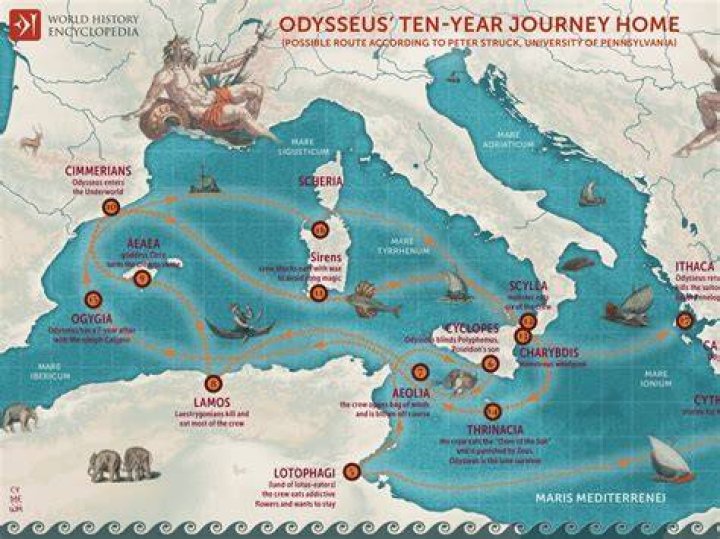
The hero's ten-year voyage encompasses some of literature's most memorable episodes. After leaving Troy, Odysseus and his men encounter the Lotus-Eaters, whose fruit induces forgetfulness and apathy. They barely escape before facing the Cyclops Polyphemus, a one-eyed giant whom Odysseus blinds to secure their escape. This act, however, earns him the wrath of Poseidon, Polyphemus's father and god of the sea.
The wind god Aeolus provides Odysseus with favorable winds trapped in a bag, but his crew's curiosity leads them to open it prematurely, blowing them off course. They later encounter the Laestrygonians, cannibalistic giants who destroy all but one of Odysseus's ships.
Circe and the Underworld
On Aeaea, the witch-goddess Circe transforms Odysseus's scouts into pigs. With help from Hermes, Odysseus resists her magic and convinces her to restore his men. Circe then advises him to journey to the underworld to consult the prophet Tiresias about his route home. This journey to Hades, known as the Nekyia, represents one of the poem's most profound sections, where Odysseus encounters the shades of famous heroes and learns difficult truths about his future.
Sirens, Scylla, and Charybdis
Circe warns Odysseus about upcoming dangers. The Sirens, whose enchanting songs lure sailors to their deaths, are bypassed when Odysseus has his crew plug their ears with beeswax while he listens tied to the mast. The narrow strait between Scylla, a six-headed monster, and Charybdis, a deadly whirlpool, forces Odysseus to choose the lesser evil, sacrificing six men to Scylla rather than risk losing his entire ship.
On the island of Thrinacia, his starving crew disobeys orders and slaughters the sacred cattle of Helios, the sun god. Zeus punishes this sacrilege with a thunderbolt that destroys the ship, killing everyone except Odysseus, who drifts to Ogygia and Calypso's seven-year captivity.
Major Themes and Their Significance
The Odyssey examines homecoming—nostos in Greek—as both physical journey and spiritual transformation. Odysseus's desire to return to Ithaca drives every decision, yet the obstacles force him to grow beyond the warrior he was at Troy. The epic suggests that true homecoming requires internal change, not merely covering distance.
Hospitality, or xenia, forms a crucial moral framework throughout the poem. The Greeks believed hosts and guests shared sacred obligations protected by Zeus himself. Good hosts like the Phaeacians prosper, while violators like the suitors or Polyphemus face divine retribution. This theme reflects ancient Greek social values while raising timeless questions about how we treat strangers.
Cunning Over Strength
Unlike many ancient heroes celebrated purely for physical prowess, Odysseus succeeds through intelligence and adaptability. His epithet "polytropos" means "of many turns" or "versatile," highlighting his ability to think creatively under pressure. He defeats Polyphemus through deception, navigates past the Sirens through cleverness, and reclaims his home through strategic planning rather than brute force alone.
The Role of Women
Female characters in The Odyssey wield remarkable power and complexity. Penelope's intelligence matches her husband's as she devises the famous shroud trick to delay the suitors for years. Athena actively intervenes throughout the story, serving as Odysseus's divine patron. Even antagonists like Circe and Calypso possess agency and depth rarely seen in ancient literature, though modern readers note the patriarchal framework within which these characters operate.
Literary Structure and Techniques
Homer employs sophisticated narrative devices that continue to influence writers today. The nonlinear timeline creates suspense and allows for dramatic irony. Readers know Odysseus survives his ordeals before he recounts them to the Phaeacians, shifting focus from whether he lives to how he overcame each challenge.
Oral tradition shaped the poem's composition. Formulaic phrases like "rosy-fingered dawn" and "wine-dark sea" aided memorization and recitation. These epithets also create rhythm and give audiences time to process information. The technique reflects The Odyssey's origins as a performance piece rather than written text.
Extended similes, comparing heroic actions to everyday activities, ground the fantastic elements in relatable reality. When Odysseus clings to a fig tree above Charybdis, Homer compares him to a judge waiting for disputants—a mundane image that makes the extraordinary moment more vivid and accessible.
Historical Context and Authorship
Scholars debate whether Homer was a single individual or a collective name for multiple bards who shaped the oral tradition over generations. The "Homeric Question" has occupied classicists for centuries without definitive resolution. Most experts agree that The Odyssey reached its current form around 725-675 BCE, during Greece's Archaic period.
The poem preserves glimpses of Bronze Age Greek society while reflecting the values of Homer's own time. Archaeological discoveries at Troy and Mycenaean sites confirm some details about palace architecture and material culture, though the poem clearly embellishes and mythologizes historical events.
Ancient Greeks considered Homer's works foundational to their education and culture. Rhapsodes traveled throughout the Greek world performing the epics, and children memorized passages as part of their schooling. This cultural saturation made The Odyssey a shared reference point for philosophy, art, and civic life across the Greek-speaking world.
Cultural Impact Through the Ages
The Odyssey's influence permeates Western culture. Roman poet Virgil directly modeled the first half of The Aeneid on it. Dante placed Homer among the greatest poets in The Divine Comedy, despite never reading Greek. James Joyce's Ulysses parallels the epic's structure in modernist Dublin. Contemporary works from Margaret Atwood's The Penelopiad to films like O Brother, Where Art Thou? reinterpret its themes for new generations.
The term "odyssey" itself entered common language, describing any long, eventful journey. We speak of "siren songs" for tempting distractions, "between Scylla and Charybdis" for impossible choices, and "Achilles' heel" for fatal weaknesses (though that detail comes from other myths about The Iliad's hero).
Modern Interpretations and Criticism
Contemporary scholarship examines The Odyssey through various critical lenses. Feminist readings analyze how the poem both empowers and constrains female characters. Postcolonial critics examine the ethnocentrism in Odysseus's encounters with "civilized" Greeks versus "barbaric" others. Psychological approaches explore the hero's trauma and identity crisis after years of war and wandering.
These reinterpretations don't diminish the epic's value but demonstrate its richness and ability to speak to changing audiences. The text contains enough complexity to support multiple, sometimes contradictory readings—a hallmark of truly great literature.
Reading The Odyssey Today
Numerous English translations make The Odyssey accessible to modern readers, each with distinct approaches. Richmond Lattimore's version prioritizes literal accuracy, preserving Homer's syntax and formulaic language. Robert Fagles creates a more contemporary, readable text that captures the poem's dramatic energy. Emily Wilson's recent translation, the first by a woman into English, uses iambic pentameter and draws attention to previously overlooked nuances in the Greek.
First-time readers often benefit from editions with introductions and notes explaining mythological references and cultural context. The poem rewards rereading, revealing new layers with each encounter. Many find listening to audio versions captures something of the oral tradition that shaped the work.
Educational and Philosophical Value
Schools continue teaching The Odyssey because it addresses fundamental questions about human nature. What defines identity when everything external changes? How do we balance ambition with responsibility to others? What costs does survival exact? When is deception justified? These questions lack simple answers, making the epic an ideal text for developing critical thinking.
The poem also provides historical insight into ancient Mediterranean cultures, their religious beliefs, social structures, and values. Students learn not just Greek mythology but how stories functioned in societies without widespread literacy, where oral poetry transmitted cultural knowledge across generations.
The Enduring Appeal
The Odyssey survives because it captures something essential about human experience. We all face obstacles on our journeys. We all long for home, however we define it. We all must choose between competing goods and navigate between dangerous extremes. Odysseus's flaws—his pride, his curiosity, his occasional cruelty—make him relatable rather than distant. His persistence in impossible circumstances offers not escapism but recognition of our own struggles.
The epic also entertains purely on adventure story merits. Monsters, magic, romance, revenge—The Odyssey delivers narrative pleasures alongside its deeper themes. This combination of accessibility and depth explains why it remains vital nearly 3,000 years after composition.
Homer's masterpiece continues shaping how we tell stories about journeys, both literal and metaphorical. Its influence appears in science fiction space operas, fantasy quests, and contemporary novels about finding one's way home. The Odyssey reminds us that some human experiences transcend time and culture, connecting us across vast historical distances through shared struggles, hopes, and the eternal desire to return home, transformed but intact.
