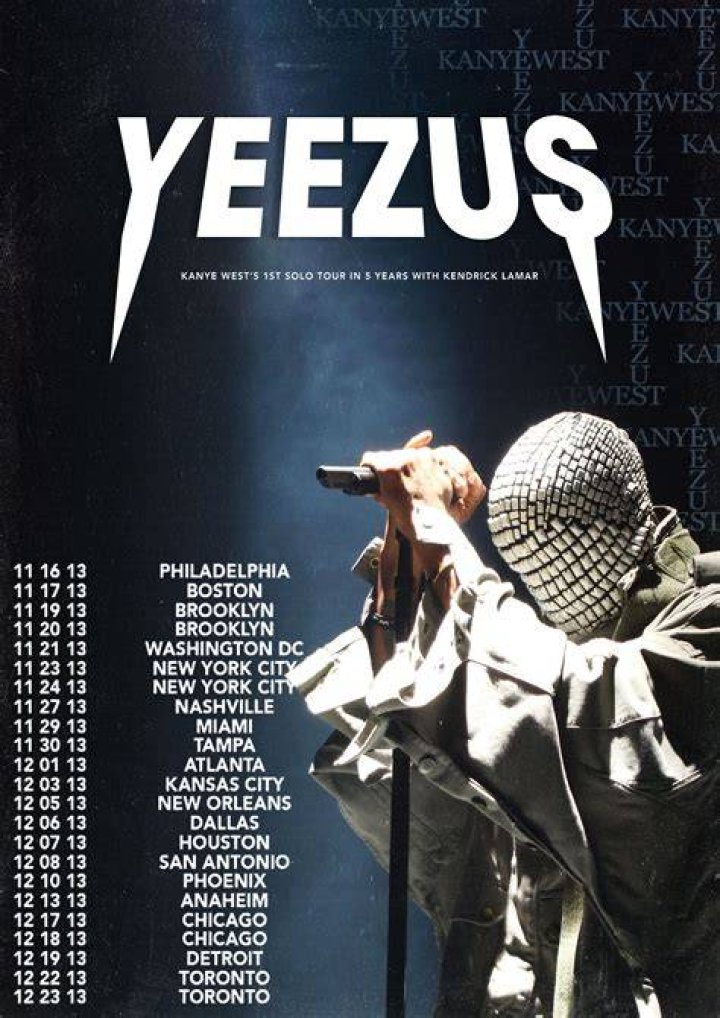
Kanye West Yeezus Advertisements: The Campaign That Broke Marketing Rules
 Mia Fernandez
When Kanye West released Yeezus in June 2013, the promotional campaign defied every conventional marketing playbook in the music industry. There were no glossy billboards. No magazine covers. No elaborate music video premieres. Instead, West and his team orchestrated one of the most talked-about and polarizing advertising campaigns in modern music history—one built almost entirely on absence, minimalism, and strategic disruption.
The Yeezus advertisements represented a radical departure from traditional album promotion. West projected his album artwork—or lack thereof—onto buildings in major cities worldwide. He eschewed digital pre-orders and streaming exclusives. The campaign became a masterclass in creating demand through scarcity, proving that sometimes the most powerful advertisement is the one that refuses to advertise at all.
The Minimalist Manifesto Behind Yeezus Marketing
Yeezus arrived with virtually no cover art. The physical CD came in a transparent jewel case with only a small strip of red tape holding it together. This stark aesthetic choice wasn't just design—it was the foundation of the entire advertising strategy. West collaborated with artist Virgil Abloh and architect Joseph Dirand to strip away everything considered essential to album packaging.
This minimalism extended to every touchpoint of the campaign. Print advertisements were sparse to the point of non-existence. Television commercials? None. The message was clear: the music would speak for itself, and the absence of traditional marketing would generate more conversation than any billboard ever could.
The approach worked spectacularly. Music journalists, fans, and critics spent weeks dissecting what the lack of imagery meant. Was it anti-commercial? Anti-art? A statement about consumerism? The ambiguity itself became the advertisement.
Guerrilla Projections That Dominated Social Media
The most visible component of the Kanye West Yeezus advertisements came in the form of large-scale video projections. West's team projected his face and various provocative imagery onto buildings in cities including New York, Los Angeles, London, Berlin, Paris, and Sydney. These weren't purchased billboard spaces—they were guerrilla marketing stunts that transformed urban architecture into temporary canvases.
One projection appeared on the side of a building in Manhattan's Soho neighborhood. Another materialized on Chicago's Wrigley Building. The projections typically featured West's face or abstract imagery related to the album's themes, accompanied by the release date.
What made these projections genius from a marketing perspective was their ephemeral nature. They appeared without warning, lasted only hours, and disappeared before authorities could respond. This created urgency. If you didn't see it in person or catch it on social media immediately, you missed it. Fans scrambled to photograph and share the projections, doing West's marketing work for him organically.
The SNL Performance That Became a Commercial
West's May 2013 performance on Saturday Night Live served as perhaps the most conventional "advertisement" for Yeezus, though even this followed his unconventional playbook. He performed "Black Skinhead" wearing a jewel-encrusted Margiela mask, backed by stark lighting and minimal staging. The performance went viral instantly, generating millions of views and becoming one of the most-discussed SNL musical performances in years.
But this wasn't a typical promotional television appearance. West didn't sit for interviews. He didn't plug the album directly. He simply performed, letting the raw intensity of the music and the visual strangeness of the presentation do the talking. The performance functioned as a standalone piece of provocative art that happened to promote an upcoming album.
Key Components of the Yeezus Advertising Strategy
- Elimination of traditional album artwork and packaging design
- Guerrilla video projections in major global cities without permits
- Minimal digital advertising and complete absence of conventional print campaigns
- No pre-release singles or music videos distributed through standard channels
- Strategic live performances that doubled as viral content
- Controversial statements and public appearances that generated organic press coverage
- A "listening experience" approach where fans discovered tracks during exclusive sessions
- Leveraging social media through scarcity and FOMO (fear of missing out)
How the Campaign Challenged Industry Standards
The music industry in 2013 was still adapting to the digital revolution. Most major releases followed a predictable pattern: lead single, music video, magazine features, morning show appearances, and saturated radio play. West threw out the entire formula.
By refusing to play by these rules, the Yeezus advertisements forced the industry to reconsider what album promotion could be. Record labels had long believed that more exposure meant more sales. West proved that strategic withholding could be equally—if not more—effective.
The campaign also demonstrated how artists with established cultural capital could bypass traditional media gatekeepers entirely. West didn't need a magazine cover because his projections generated more online discussion than any print feature could. He didn't need radio play because the mystique surrounding the album created its own momentum.
Reception and Cultural Impact
Response to the Yeezus marketing campaign was deeply divided. Advertising professionals praised its boldness and innovation. Several marketing publications featured analyses of the strategy, with some calling it a blueprint for future album campaigns. The minimalist approach influenced subsequent releases by other artists who similarly experimented with anti-commercial aesthetics.
Critics, however, accused West of pretension and artistic self-indulgence. Some argued that only an artist of West's stature could afford such a risky strategy—an unknown musician attempting the same approach would likely fail. Others questioned whether the campaign was truly revolutionary or simply benefited from West's existing fame and media obsession with his every move.
Commercially, Yeezus debuted at number one on the Billboard 200, selling 327,000 copies in its first week despite the unconventional promotion. While these numbers were lower than West's previous albums, they were strong enough to validate the experimental approach, especially considering the album's challenging, abrasive sound.
The Role of Controversy in Amplifying the Message
Part of what made the Yeezus advertisements so effective was West's willingness to court controversy. During the promotional period, he gave interviews where he compared himself to Steve Jobs and Walt Disney. He made provocative statements about race, class, and the fashion industry. Each controversial comment generated headlines that kept Yeezus in the public conversation.
Whether these statements were calculated marketing moves or genuine expressions of West's ego remains debatable. What's undeniable is that they functioned as free advertising. Every think piece, social media debate, and news segment about West's latest outrageous claim reinforced awareness of his upcoming album.
Technical Execution of the Projection Campaign
The logistical complexity behind the guerrilla projection advertisements was substantial. West's team needed high-powered projectors capable of casting clear images onto buildings from significant distances. They had to scout locations, time projections to maximize visibility while minimizing interference from authorities, and coordinate across multiple cities simultaneously.
The projections typically occurred at night for maximum visibility. Teams would set up equipment quickly, run the projection for 30 minutes to several hours, then dismantle before police or building owners could intervene. This required precise planning and execution—one wrong move could result in equipment confiscation or legal trouble.
The technical team reportedly used high-lumen projectors typically reserved for large events or architectural installations. Some projections stretched several stories high, requiring specialized equipment and expert positioning to achieve proper focus and brightness.
Frequently Asked Questions
Why did Kanye West choose such minimal advertising for Yeezus?
West embraced minimalism as both an artistic statement and a strategic marketing decision. The absence of traditional advertising created intrigue and conversation, turning the lack of promotion into promotion itself. The approach aligned with the album's raw, stripped-down sound and challenged music industry conventions about how albums should be marketed. By doing less, West paradoxically generated more attention and discussion than a conventional campaign might have achieved.
Were the Yeezus building projections legal?
Most of the guerrilla projections for Yeezus existed in a legal gray area. Projecting images onto buildings without permission typically violates local ordinances and property rights. However, because the projections were temporary and caused no physical damage, enforcement was inconsistent. In most cases, the projections were removed before authorities responded, or operators faced only minor citations. The legal risk was apparently part of the campaign's rebellious appeal.
Did the Yeezus advertising campaign influence other artists?
Yes, the Yeezus campaign influenced numerous artists and their marketing teams. Several major releases in subsequent years adopted elements of West's strategy, including minimalist artwork, guerrilla marketing tactics, and social-media-first promotional approaches. Artists like Beyoncé, Frank Ocean, and Radiohead experimented with surprise releases and unconventional rollouts partly inspired by West's willingness to break industry norms. The campaign demonstrated that established artists could successfully market albums without following traditional promotional formulas.
Final Thoughts
The Kanye West Yeezus advertisements remain a landmark moment in music marketing. Whether you view the campaign as brilliant innovation or self-indulgent spectacle, its impact on how artists approach album promotion is undeniable. West proved that in an oversaturated media landscape, sometimes the most effective strategy is subtraction rather than addition. The projections, the missing artwork, the absence of singles—these weren't just creative choices. They were calculated provocations designed to make audiences lean in rather than tune out. A decade later, the campaign still sparks debate among marketers, musicians, and fans about where art ends and advertising begins.